
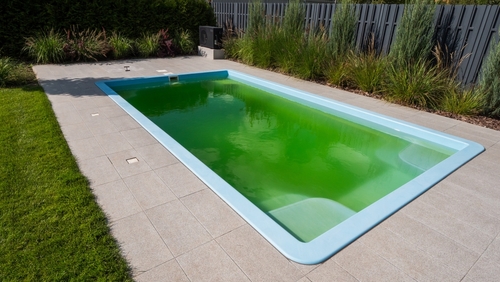
Why Is Pool Water Still Green After Shocking?
Many homeowners have experienced this frustrating situation, and they feel perplexed about what may be the cause. You expect sparkling, clear water the next morning after you pour in a considerable amount of pool shock. Instead, the pool remains stubbornly green. Sometimes, the green coloring becomes even more pronounced. It’s natural to wonder why this essential cleaning step failed to have the outcome that you expected, especially if you have correctly measured and applied the strong chlorine product. Here are some reasons that this happens.
Abundance of Algae
What many homeowners do not realize is that an abundance of algae is normally responsible for why pool water is still green after shocking. Shocking is the process of adding a large, concentrated dose of chlorine to kill these contaminants. This frees up combined chlorine molecules. However, if the pool is heavily contaminated, there may not be enough shock treatment to kill the algae that is present.
Not Using Enough Chlorine
A very common mistake that so many homeowners make is consistently adding the standard amount of chlorine, even though more may be needed. The considerable volume of algae will immediately consume the chlorine that is added to the pool. When this happens, there is no residual sanitizer to keep the water clean. The algae will continue to multiply rapidly because this initial dose was insufficient.
Imbalance in Water Chemistry
Another major factor that prevents shocking from working correctly is if the water chemistry is off balance. Chlorine is a powerful sanitizer. But for it to be effective at all, the pool’s pH must be at ideal levels. The pH scale measures the acidity of the water. The pH of your pool water should ideally be between 7.4 and 7.6 for chlorine to do its job properly. The chlorine will become chemically sluggish if your pH is too high, especially if levels are at 8.0 or above. Because all the chlorine is inactive at this point, the algae will continue to thrive and reproduce.
Debris in the Pool
Having leaves and dirt in the water can also be responsible for a green pool after shock treatment. The chlorine has to use up all its energy to break down this debris. This leaves nothing left over to contend with the algae.
You must make certain that the pump and filter are running continuously during and after the shock treatment to help collect the dead algae and contaminants. This will prevent the pool from reverting to its previous green state.
Heavy Metals
The presence of heavy metals, such as copper or iron, can turn water green when they are oxidized by chlorine. Although this color is not caused by algae, many pool owners mistake it for an algae bloom. If the water turns a bluish-green or a brownish-green immediately after shocking, you may need a sequestering agent to bind and remove the metals. Adding more chlorine will not solve the problem.
So that you do not waste your time and money on using the wrong chemicals, it is strongly advised that you procure a high-quality test kit. Such kits will provide you with adequate information that will help you tweak your pool cleaning routine so that you can avoid contending with the frustration of a green pool after shock treatment. Periodically working with a professional can also be helpful. They can find and fix problems that have been lurking beneath the surface before they get out of control.